
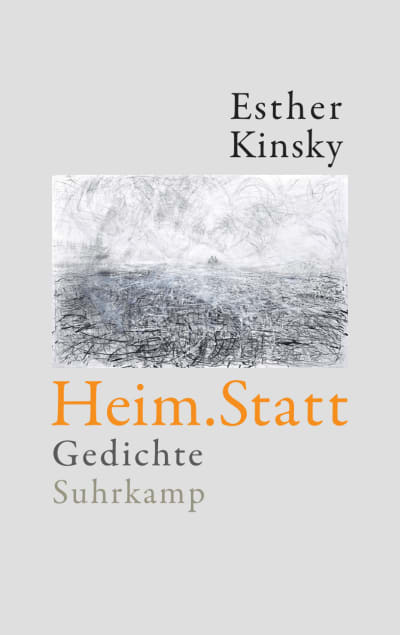



The new, moving cycle of poems by Esther Kinsky
»When a shoot of the rose of paradise has been grafted onto all roses, all errant wanderers will find their way home.«
Images of flight, dispossession, and injury, spanning millennia, in history and myth: Eurydice, frantically fleeing from a god that is stalking her, fails to notice the serpent and dies from its poisonous bite. Landless cottagers in northern Scotland, relocated to less fertile land or forced to emigrate. A young German nobelwoman, educated and gifted, resists the »given«, the »morals of complaisance« of her social status. A maid in Poland transforms into a bird, escaping poverty and the...
Images of flight, dispossession, and injury, spanning millennia, in history and myth: Eurydice, frantically fleeing from a god that is stalking her, fails to notice the serpent and dies from its poisonous bite. Landless cottagers in northern Scotland, relocated to less fertile land or forced to emigrate. A young German nobelwoman, educated and gifted, resists the »given«, the »morals of complaisance« of her social status. A maid in Poland transforms into a bird, escaping poverty and the indignities of life. On the northern border of Italy, after being left on their own for months, women refuse to use human language after the return of the men.
Esther Kinsky’s Home is a work cycle made up of seven long, plurivocal poems which, connected by brief, adjoining texts, bring together and crystallise recurring motifs of the violence, injury, and silence related to the overarching theme of flight and refuge. Kinsky finds moving images to illustrate how loss and the desire to start again have always been a component of human existence, providing sources of both hope and trauma.
Persons
Esther Kinsky
OTHER PUBLICATIONS

Seeing Farther
On a journey through the south-east of Hungary, the narrator stops off in an almost completely deserted village on the border to Romania. Resignation and a glorification of the past are the most...
USA & Canada (NYRB), UK & Commonwealth (Fitzcarraldo), Spanish world rights (Periférica), Portuguese rights (Elsinore), France (Christian Bourgois), Italy (Iperborea), Netherlands (Pluim), Sweden (Filmögon), Hungary (Jelenkor)

The Captain and Mimi Catt

Rombo
USA & Canada (NYRB), UK & Commonwealth (Fitzcarraldo), Spanish world rights (Periférica), Catalan rights (Angle), Portugal (Elsinore), France (Christian Bourgois), Italy (Iperborea), Netherlands (Pluim), Denmark (Atlanten), Norway (Forlaget Press), Finland (Lurra), Japan (Hakusuisha), Poland (Drzazgi), Turkey (Axis)

Slates
Esther Kinsky’s new book is dedicated to slate, the polymorphic, versatile sedimentary rock, and to the Slate Islands, a small archipelago off the West coast of Scotland. For centuries, slate was...
English world rights (Fitzcarraldo), France (Editions Grèges)

Grove
Grove is a novel in three parts, each following a different journey through...
UK & Commonwealth (Fitzcarraldo), USA & Canada (Transit Books), Spanish world rights (Periférica), France (Grasset), Italy (Il Saggiatore), Netherlands (Pluim), Denmark (Atlanten), Finland (Lurra), Korea (East-Asia Publishing), Greece (Potamos), Ukraine (Knihy XXI)