


Rights sold to:
English world rights (New Directions)
A Pound of Oranges / Ein Pfund Orangen und neun andere Geschichten
And Nine Other Stories by Ingolstadt’s Marieluise Fleißer
The first book published by Marieluise Fleißer, a modern German classic waiting to be properly rediscovered internationally
These »bonafide Ingolstadt original novellas”, which were published in 1929 under the title A Pound of Oranges, were Marieluise Fleißer’s first book publication. Lion Feuchtwanger and Bertolt Brecht had encouraged the then 26-year-old author to publish them. The book was praised by critics, including Walter Benjamin, who wrote:
»This woman enriches our literature, adding to it the rare performance of unpigheaded provincial pride. She is simply of the belief that people in...
»This woman enriches our literature, adding to it the rare performance of unpigheaded provincial pride. She is simply of the belief that people in...
Read more
These »bonafide Ingolstadt original novellas”, which were published in 1929 under the title A Pound of Oranges, were Marieluise Fleißer’s first book publication. Lion Feuchtwanger and Bertolt Brecht had encouraged the then 26-year-old author to publish them. The book was praised by critics, including Walter Benjamin, who wrote:
»This woman enriches our literature, adding to it the rare performance of unpigheaded provincial pride. She is simply of the belief that people in the provinces have experiences that can compete with the big Life in the metropolises; indeed, she considers these experiences important enough to build her authorship around them.«
»This woman enriches our literature, adding to it the rare performance of unpigheaded provincial pride. She is simply of the belief that people in the provinces have experiences that can compete with the big Life in the metropolises; indeed, she considers these experiences important enough to build her authorship around them.«
1929, 138 pages

Persons
Marieluise Fleißer
Author
Marieluise Fleißer was born in 1901 in Ingolstadt, where she died in 1974. The »greatest female playwright of the 20th century« (Elfriede Jelinek) was rediscovered – after earlier successes in the periphery of Bertolt Brecht – by young playwrights like Rainer Werner Faßbinder and Franz Xaver Kroetz in the 1960s. Subsequently, her plays were performed again, and at last a larger audience also got to see her as a narrator, although Walter Benjamin had already recognised Marieluise Fleißer's prose as an »art form of the first order« early on and Alfred Kerr had simply called her work »an asset«.
Marieluise Fleißer
Author
Marieluise Fleißer was born in 1901 in Ingolstadt, where she died in 1974. The »greatest female playwright of the 20th century«...
© Suhrkamp Verlag
OTHER PUBLICATIONS
Latest first

Year of Publication: 2020
Marieluise FleißerYear of Publication: 2020
The Ingolstadt Plays
Comprising the pieces »Purgatory in Ingolsatdt« and »Pioneers in Ingolstadt«, Marieluise Fleißer’s Ingolstadt plays, which caused an absolute scandal when they were first staged in the 1920s, feature...
Rights sold to:
France (Brigadier), Portuguese rights (Artistas Unidos)
Previously published in the respective language / territory; rights available again: English world rights (Purgatory in Ingolstadt, Methuen), Italy (Graphiservice S.r.l.)
Year of Publication: 1931
Marieluise FleißerYear of Publication: 1931
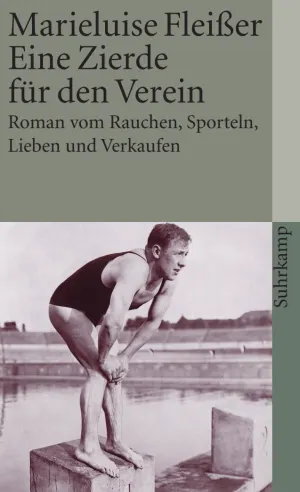
A Credit to the Club
In the seeming idyll of the German province in the years before 1933, Gustl Gillich, small-town man, owner of a tobacco shop and a local swimming phenomenon, tries hard to win the affections of...
Rights sold to:
English world rights (New Directions), Spanish world rights (Caleidoscopio de libros), France (Actes Sud), Denmark (Harpyie)