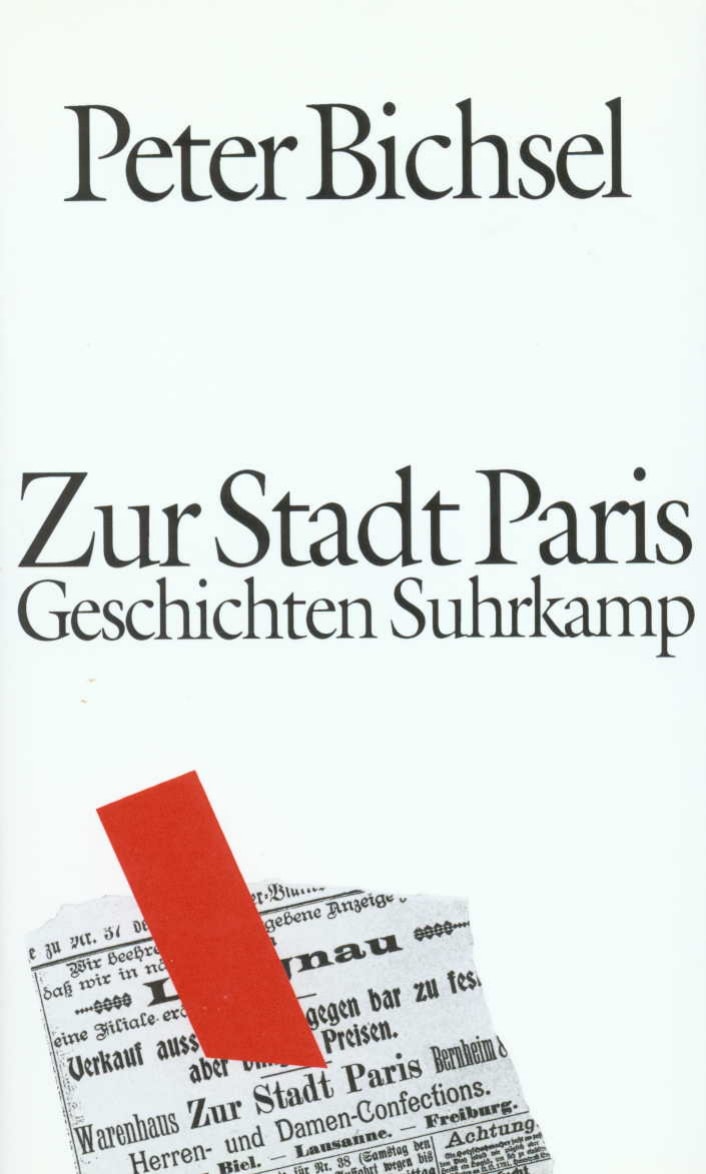
On the City of Paris

Thailand (Gamme Magie Éditions), Azerbaijan (Alatoran), Iran (Nashr-i Naw)
Previously published in the respective language / territory; rights available again: French rights (Éditions d’en bas), Italy (Marcos y Marcos), Norway (Gyldendal Norsk), Turkey (Ayrac), India (Bengali, Tarjama Books), India (English, Tarjama Books), Israel (Babel)
»I believe«, says Peter Bichsel, »that the importance of literature lies not in conveying content but in maintaining storytelling. Because people need stories to survive. They need models with which they can narrate their own lives to themselves. Only a life you can tell yourself is a meaningful life.« And: »I would like to counteract history with stories.«
The world of Peter Bichsel – and therefore too the world of his stories in...
»I believe«, says Peter Bichsel, »that the importance of literature lies not in conveying content but in maintaining storytelling. Because people need stories to survive. They need models with which they can narrate their own lives to themselves. Only a life you can tell yourself is a meaningful life.« And: »I would like to counteract history with stories.«
The world of Peter Bichsel – and therefore too the world of his stories in On the City of Paris – is never certain, i.e. never defined and unambiguous, but always open and an invitation to everyone to follow both the author’s imagination as well as their own in order to search for love, hope and comfort in the richness of life. With everything that he seemingly coincidentally encounters at all hours of the day and the night, Peter Bichsel points to worlds in which there is nothing that is unfamiliar to people. And so he conceives, invents and narrates biographies that are both improbable and true at the same time: And so in Bichsel’s To the City of Paris we meet the Bleary-Eyed Guy with the magic touch as well as Albert Weisshaupt, who has an embarrassing predisposition to crying, or Erwin, who is considered a fraud by his drinking buddies, and the old Fiddler Zingg or the young woman who lives, »on the whole not at all unhappy« near Rome with her three children, her husband and no appendix. And Bichsel’s characters have a quality that makes them instantly likeable: They exude warmth, because they are all loved by their author – whether they are industrialists, footballers or simply poor devils, drunks, teetotallers, idiots or know-it-alls, children, elderly widows or Inuit in New York.
With On the City of Paris Peter Bichsel has successfully written a volume of stories that tells us readers – sometimes in shorter bursts, then again with longer wind – that it’s the small things, the minimal, the inconspicuous right in front of our eyes that, if observed closely or simply given the opportunity to speak, reveals everything about us. »The lifer, asked about how he bears or handles everything, all those years in prison, replies: You know, I always tell myself that the time I’m spending in here, I’d have to spend on the outside as well.«