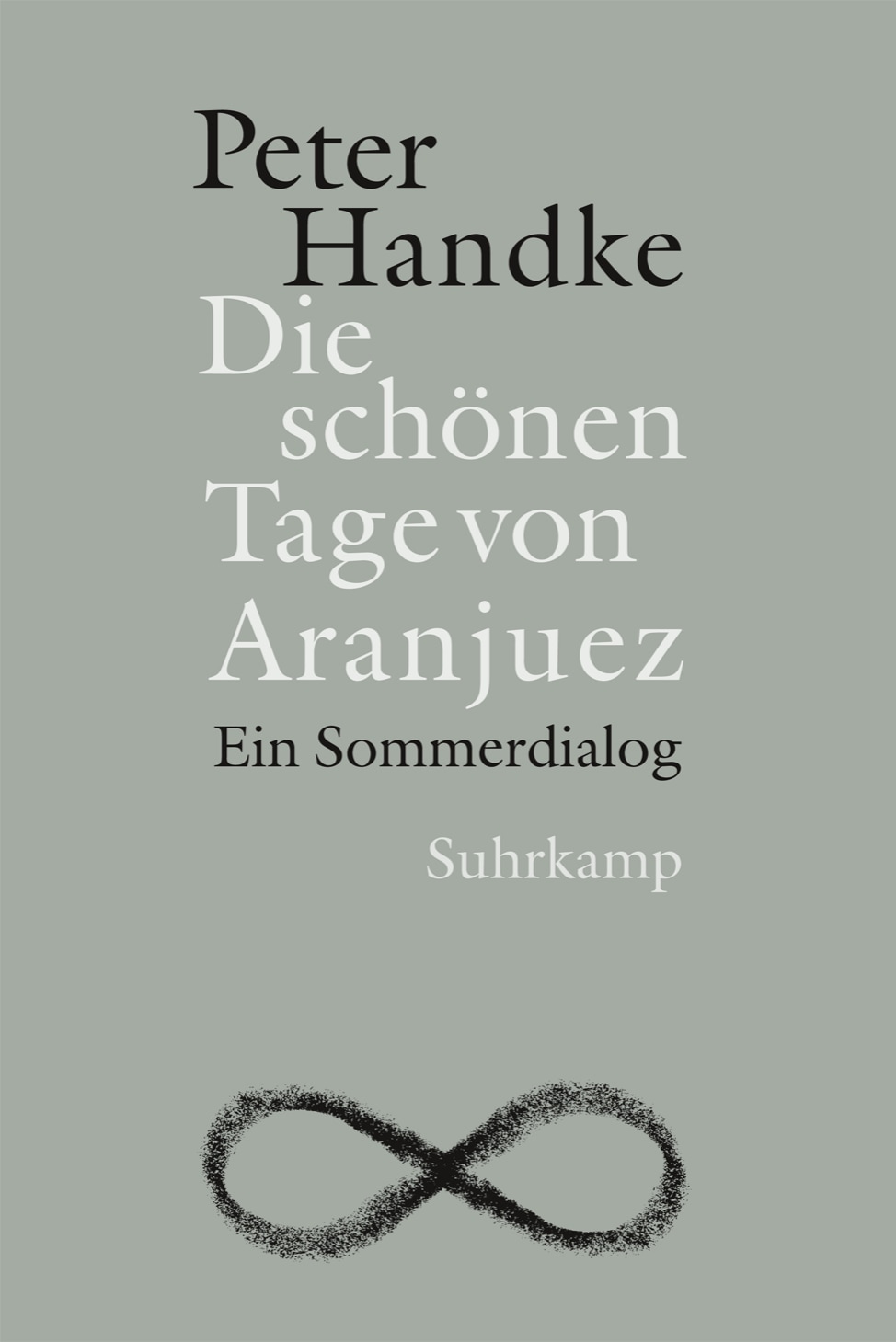
The Beautiful Days of Aranjuez


Spanish world rights (Casus Belli), France (Bruit du Temps), Italy (Quodlibet), Norway (Samlaget), Japan (Ronsosha), Serbia (Laguna), Slovenia (Hermagoras/Mohorjeva založba), Greece (Vakxikon)
»And again summer. And again a beautiful summer day. And again a woman and a man at a table outdoors, in the fresh air. A garden. A terrace. Invisible, but...
Characters: a nameless woman, a nameless man: a simple couple. They meet in order to talk about love, first loves, and what a man and a woman feel when they are with each other. They talk about how you talk about love. For whoever talks about love, inevitably talks about nature, about history – about that which gives life meaning.
»And again summer. And again a beautiful summer day. And again a woman and a man at a table outdoors, in the fresh air. A garden. A terrace. Invisible, but audible trees, more suggestion than presence in a soft summer wind that, from time to time, gives a rhythm to the scenery. The table is a garden table, somewhat large, and the man and woman are sitting at a distance to each other. They are both wearing non-descript summer clothes, the woman’s rather brighter, the man’s rather darker, classic, the one as the other.«
»Once again a Handke-drug has fallen from out of the clouds, and, curiously, from out of a cloudless sky, right down upon us readers, and this time that drug is called The Beautiful Days of Aranjuez.« Frankfurter Allgemeine Sonntagszeitung
»Handke’s latest piece is a perfectly structured, sleepy, and ironic sigh beneath the apple trees.« Deutschlandradio Kultur
»Fable-like […] A hallucination in words. Quite delicate, quite heavy.« Wiener Zeitung
»Handke is the last of the great poets.” Neue Westfälische
»Germany can be happy to have such a great (theatre) author like Peter Handke. The Beautiful Days of Aranjuez is a wonderful read that goes straight to your heart and makes it lighter.« literaturmarkt.info
»And tender and feather-light this two-person piece remains until the final line, despite the difficult theme that the two protagonists have taken upon themselves.« Eßlinger Zeitung
»In this tender little book from the 69-year-old novelist and dramatist the couple has been taken from real life […]« Weser-Kurier
»Handke’s latest piece is a perfectly structured, sleepy, and ironic sigh beneath the apple trees.« Deutschlandradio Kultur
»Fable-like […] A hallucination in words. Quite delicate, quite heavy.« Wiener...