
English world rights (Polity; audiobook rights: Echo Point), Spanish world rights (Katz Editores), Chinese simplex rights (Shanghai People’s Publishing House), France (La Découverte), Italy (Cortina), Denmark (Eksistensen), Norway (Cappelen Damm), Japan (Shinsensha), Turkey (Albaraka)
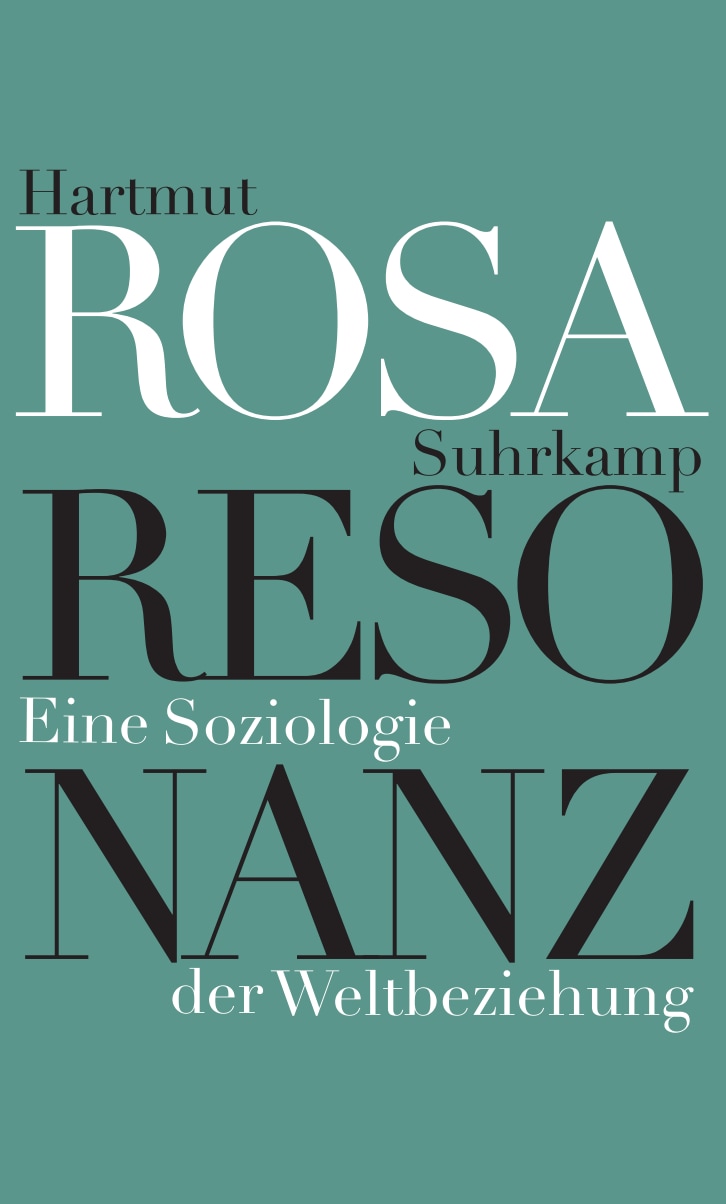
If acceleration is the problem, then perhaps resonance is the solution. This, in the briefest possible terms, is the central thesis of Hartmut Rosa’s latest book, which can be seen as the founding document of a sociology of the good life. It begins with the assertion that the quality of a human life cannot be measured in terms of resources, options, or moments of happiness. Rather, we should turn our attention to the connection to the world that informs that life and which, so long as that connection is intact, is an expression of stable relationships of resonance.
To support this claim, Rosa begins by presenting the entire spectrum of ways in which we establish a connection to the world, everything from breathing to culturally differentiated worldviews. Next, he turns his attention to the concrete experiential and agential spheres – e.g. family and politics, work and sport, religion and art – where we look for resonance, but find it less and less often. This in turn is linked to the accelerationary logic of modernity, which is both the cause and the effect of a broken connection to the world, individually and collectively.
With this comprehensive reconstruction of modernity, Hartmut Rosa makes a bold attempt to sketch the outline of a new critical theory.
»With his […] smoothly and lucidly written book, Rosa […] presents nothing less than a comprehensive theory of all human life.« Micha Brumlik, Blätter für deutsche und internationale Politik 5/2016
»Those interested in a critical diagnoses of the present age will not be able to pass on Rosa’s book.« Stuttgarter Nachrichten Online
»Despite its not immodest scope, this epochal and enlightening work, which picks up on a fundamental problem of advanced modernity, can also be read by non-sociologists.« Zeitschrift für Sozialökonomie
»With his […] smoothly and lucidly written book, Rosa […] presents nothing less than a comprehensive theory of all human life.« Micha Brumlik, Blätter für deutsche und internationale Politik 5/2016
»Those interested in a critical diagnoses of the present age will not be able to pass on Rosa’s book.« Stuttgarter Nachrichten Online
»Despite its not immodest scope, this epochal and enlightening work, which picks up on a fundamental problem of advanced...