
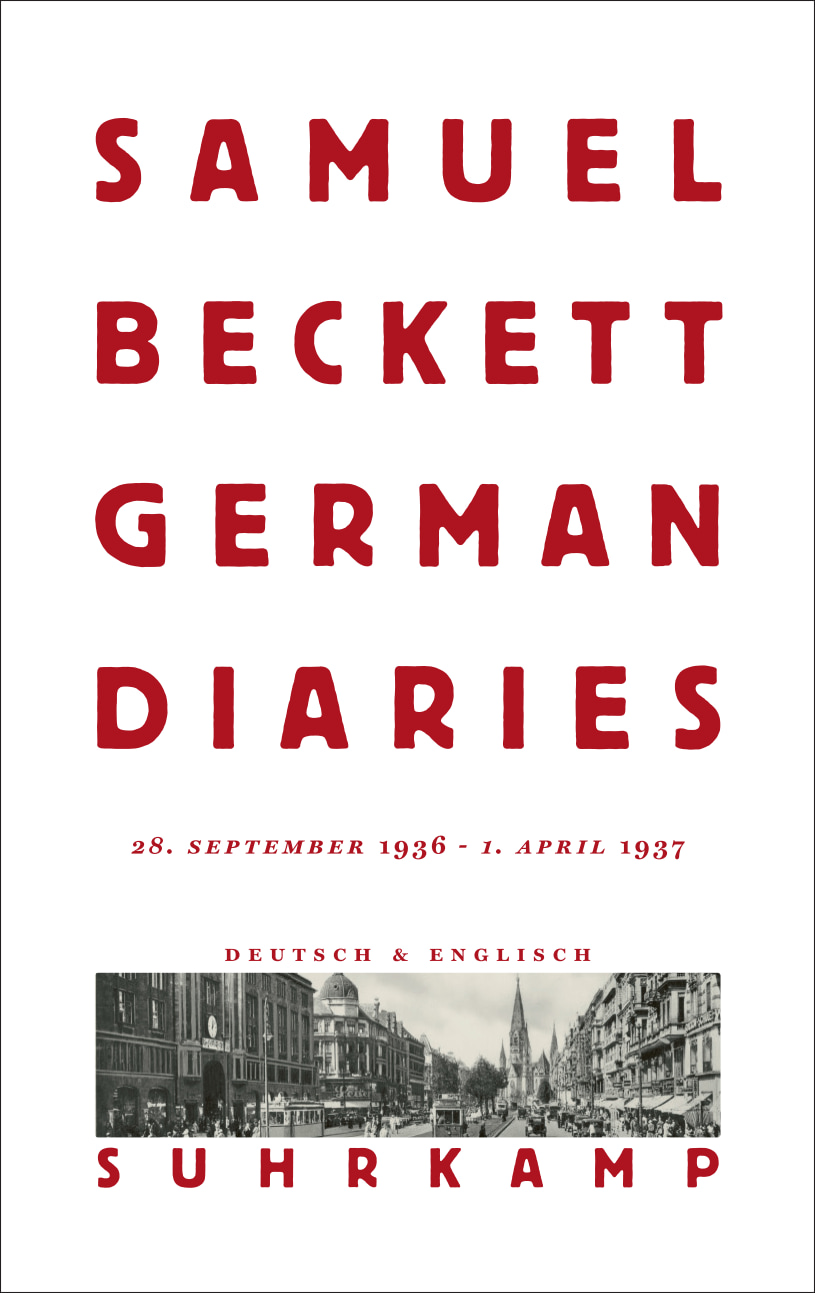
German Diaries
28 September 1936–1 April 1937
Text and Commentary. Edited by Mark Nixon and Oliver Lubrich. With Illustrations


Rights sold to:
USA (Grove), UK & Commonwealth (Faber), Chinese simplex rights (Hunan Literature & Art), Portugal (Almedina), France (Minuit), Italy (Einaudi), Korea (Workroom Press), Greece (Oblik)
Domestic rights sales: German radio adaptation (Deutschlandradio)German Diaries / German Diaries
28 September 1936–1 April 1937
Text and Commentary. Edited by Mark Nixon and Oliver Lubrich. With Illustrations
A major literary event – the last significant unpublished writings by one of the major figures of 20th-century letters
Samuel Beckett only kept a diary for a prolonged period of time once in his life, and that was on his travels through Germany from September 1936 to April 1937, which saw him visiting cities such as Hamburg, Berlin, Dresden, and Munich. The six extensive notebooks he filled during this time ended up among his literary remains.
The »German Diaries« represent the last significant unpublished writings by Beckett. They provide insights into the evolution of Beckett’s aesthetics...
The »German Diaries« represent the last significant unpublished writings by Beckett. They provide insights into the evolution of Beckett’s aesthetics...
Read more
Samuel Beckett only kept a diary for a prolonged period of time once in his life, and that was on his travels through Germany from September 1936 to April 1937, which saw him visiting cities such as Hamburg, Berlin, Dresden, and Munich. The six extensive notebooks he filled during this time ended up among his literary remains.
The »German Diaries« represent the last significant unpublished writings by Beckett. They provide insights into the evolution of Beckett’s aesthetics in his critical confrontation with literature and visual art. But also into the motivations behind his decision to embark upon this trip. They are of historical significance because of the unerring eye with which the young Irish author views the Germany of the early Nazi years as a participant observer.
Beckett comes face to face with the effects of the Nazis’ cultural policies when he inspects pictures that have been removed from display in museums and placed in storage, and in conversations with artists and collectors. The entire text is shot through with sharply detailed observations on everyday life in Hitler’s Germany.
In addition to Beckett’s notes, which are scattered with German words and turns of phrase and published here for the very first time, the publication also includes annotations from the editors, as well as an afterword by the editor and German translator, including overviews and a glossary, which help to decode the diaries.
The »German Diaries« represent the last significant unpublished writings by Beckett. They provide insights into the evolution of Beckett’s aesthetics in his critical confrontation with literature and visual art. But also into the motivations behind his decision to embark upon this trip. They are of historical significance because of the unerring eye with which the young Irish author views the Germany of the early Nazi years as a participant observer.
Beckett comes face to face with the effects of the Nazis’ cultural policies when he inspects pictures that have been removed from display in museums and placed in storage, and in conversations with artists and collectors. The entire text is shot through with sharply detailed observations on everyday life in Hitler’s Germany.
In addition to Beckett’s notes, which are scattered with German words and turns of phrase and published here for the very first time, the publication also includes annotations from the editors, as well as an afterword by the editor and German translator, including overviews and a glossary, which help to decode the diaries.
»[Beckett's] perspective is like that of a time traveller sent from our age into the 1930s.«Jens Jessen, DIE ZEIT
»Sensational diaries.« Dirk Schümer, WELT AM SONNTAG
»Sensational diaries.« Dirk Schümer, WELT AM SONNTAG
»[Beckett's] perspective is like that of a time traveller sent from our age into the 1930s.«Jens Jessen, DIE ZEIT
»Sensational diaries.« Dirk Schümer, WELT AM SONNTAG
»Sensational diaries.« Dirk Schümer, WELT AM SONNTAG
2026, 1352 pages
Persons
Samuel Beckett
Author
Samuel Beckett was born on 13 April 1906 in Dublin and passed away on 22 December 1989 in Paris. He is one of the most important writers of the 20th century and received the Nobel Prize for Literature in 1969. While Beckett is best known for his plays (the most famous of which is Waiting for Godot), he also wrote prose and poetry.
Samuel Beckett
Author
Samuel Beckett was born on 13 April 1906 in Dublin and passed away on 22 December 1989 in Paris. He is one of the most important writers of the 20th...
© Jerry Bauer