
The Conditions of Our Existence
On the Contemporary Relevance of Michel Foucault

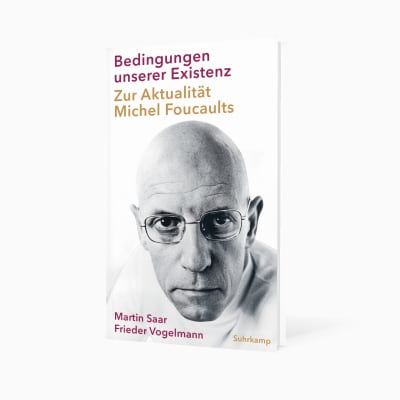

The Conditions of Our Existence / Bedingungen unserer Existenz
On the Contemporary Relevance of Michel Foucault
Foucault today: on the legacy of one of the great thinkers of the twentieth century
How do we view Michel Foucault today? How might we assess the impact of his widely read and much-criticised work in the present day? While his oeuvre is viewed as canonical for the humanities, cultural studies, and social sciences, his thought is regularly blamed with leading to some of the irrational aberrations and relativist dead ends of contemporary thought.
In their astute philosophical exploration of Foucault’s legacy, Martin Saar and Frieder Vogelmann present him...
In their astute philosophical exploration of Foucault’s legacy, Martin Saar and Frieder Vogelmann present him...
Read more
How do we view Michel Foucault today? How might we assess the impact of his widely read and much-criticised work in the present day? While his oeuvre is viewed as canonical for the humanities, cultural studies, and social sciences, his thought is regularly blamed with leading to some of the irrational aberrations and relativist dead ends of contemporary thought.
In their astute philosophical exploration of Foucault’s legacy, Martin Saar and Frieder Vogelmann present him neither an unassailable authority nor do they find in his work a dissolution of truth, an absolutisation of identity, or a fragmentation of politics. Rather, they uncover a highly agile diagnostic mode of thought dedicated to examining the preconditions of what is deemed true, authentic, or legitimate in any given context. Foucault’s famous distancing manoeuvres are primarily an expression of a style of thinking aimed at intervening in political and social reality. Foucault’s philosophical critique is concerned with nothing less than the very conditions of our existence.
In their astute philosophical exploration of Foucault’s legacy, Martin Saar and Frieder Vogelmann present him neither an unassailable authority nor do they find in his work a dissolution of truth, an absolutisation of identity, or a fragmentation of politics. Rather, they uncover a highly agile diagnostic mode of thought dedicated to examining the preconditions of what is deemed true, authentic, or legitimate in any given context. Foucault’s famous distancing manoeuvres are primarily an expression of a style of thinking aimed at intervening in political and social reality. Foucault’s philosophical critique is concerned with nothing less than the very conditions of our existence.
2026, 233 pages
Persons
OTHER PUBLICATIONS
Latest first

Year of Publication: 2025
Martin SaarYear of Publication: 2025
What Is Social Philosophy
Since Max Horkheimer's formative essays were written almost 100 years ago, »social philosophy« has been understood as a discipline that does not just deliver an examination of one philosophical object of study among others. Instead it implies a specific, critical approach to contemporary society. In this collection of programmatic essays, Martin Saar interrogates the deployment, the gestures, the...

Year of Publication: 2022
Frieder VogelmannYear of Publication: 2022
The Effectiveness of Knowledge
Political epistemology poses a demanding task: in order to do justice to the internal relationships between truth and knowledge on the one hand, and politics and society on the other, it must reformulate the concepts of both epistemology and social and political theory. For the concept of knowledge, this means taking equal account of the truth and the efficacy of knowledge. In his fundamental...

Year of Publication: 2013
Martin SaarYear of Publication: 2013
The Immanence of Power
Every age discovers and interprets its classics of philosophy anew; therefore, the current acute interest in the work of the Dutch reationalist Baruch de Spinoza says at least as much about the present as it does about the early modern period. For an important alternative, one that has not yet been exhausted, to the better known paths into modernity in terms of the history of ideas becomes...