
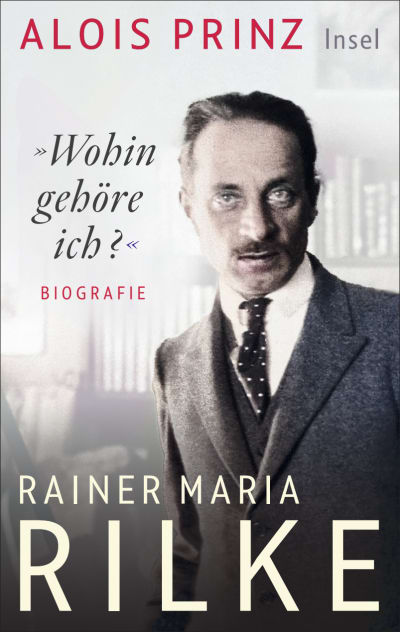

This silence was not an unfounded bout of writer's block, but for Rilke the appropriate and only possible response to the madness of war. For him, poetry and war were mutually exclusive. This incompatibility prompted him to define his self-image as a poet and his conception of poetics more sharply in contrast to war, while at the same time making his stance on war clear. In this respect, Rilke was by no means the unworldly aesthete he is often portrayed as. Hundreds of letters prove that he was a keen observer of his time and that his political views – which he always placed in a broader context – were more illuminating than those of many of his contemporaries. If we think about this »political« incarnation of Rilke, it becomes easier to understand his traumatic experiences in his childhood and youth, his relationship with his family, and his friendships with women.

Persons
Alois Prinz
Alois Prinz, born in 1958, studied literature and philosophy in Munich and now lives in Kirchheim near Munich with his family. He has published numerous biographies, including ones on Georg Forster, Hermann Hesse, Ulrike Marie Meinhof and Franz Kafka. Awards for his work include the German Youth Literature Prize and the Evangelical Book Prize. 2012 saw the publication of his book Hannah Arendt oder Die Liebe zur Welt, which sold more than 130,000 copies. In 2017 he was awarded the Grand Prize of the German Academy for Children’s and YA Fiction and in 2018 the Annual EMYS Award for Best YA Non-Fiction.
Alois Prinz, born in 1958, studied literature and philosophy in Munich and now lives in Kirchheim near Munich with his family. He has published...