
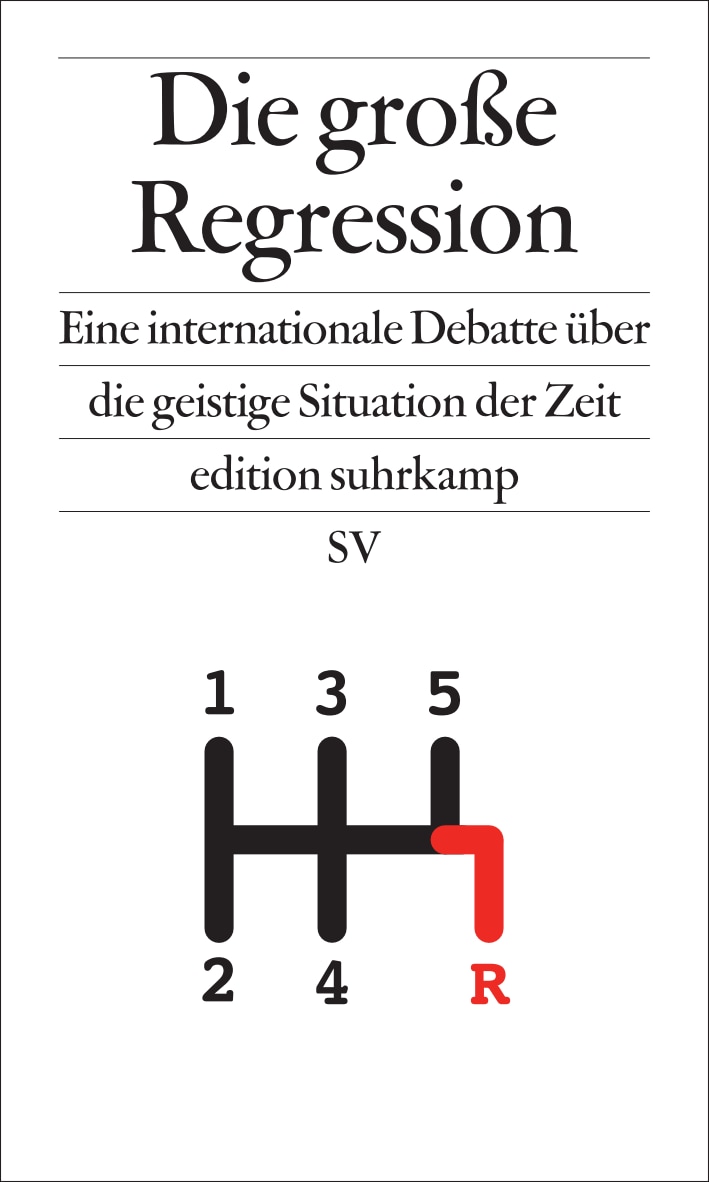
The Great Regression


English world rights (Polity), Spanish world rights (Seix Barral), Catalan rights (Grup 62), Chinese simplex rights (Horizon), Brazilian Portuguese rights (Estação Liberdade), Korea (Sallim), Portugal (PRH – Objectiva), France (Premier Parallèle; Paperback Sublicense: Gallimard Folio), Italy (Feltrinelli), Netherlands (Atlas Contact), Czech Republic (Rybka), Romania (ART), Turkey (Metis)
Previously published in the respective language / territory; rights available again: Bulgaria (KX Critique & Humanism)
At the latest, since the effects of the financial crisis became clear and migration to the European Union began to grow, we have seen developments that many had thought were the phenomena of a distant age: the rise of nationalistic, in part anti-liberal parties like the Front National and the Alternative für Deutschland, the profound crisis of the EU, a coarsening of public discourse thanks to demagogues like Donald Trump, a growing distrust of the established media and the spread of...
At the latest, since the effects of the financial crisis became clear and migration to the European Union began to grow, we have seen developments that many had thought were the phenomena of a distant age: the rise of nationalistic, in part anti-liberal parties like the Front National and the Alternative für Deutschland, the profound crisis of the EU, a coarsening of public discourse thanks to demagogues like Donald Trump, a growing distrust of the established media and the spread of xenophobic ideas... all of which are a reminder of dark times. Politicians are vilified as »traitors to the fatherland«, Muslims are under general suspicion and the internet is awash with the crudest of conspiracy theories.
In this collection, internationally renowned researchers and intellectuals examine the causes of this »Great Regression«, locate them in a historical context, introduce scenarios for the coming years and discuss strategies we can use to resist such developments.
With contributions from Arjun Appadurai, Zygmunt Bauman, Donatella della Porta, Nancy Fraser, Eva Illouz, Ivan Krastev, Bruno Latour, Paul Mason, Pankaj Mishra, Robert Misik, Oliver Nachtwey, César Rendueles, Wolfgang Streeck, David Van Reybrouck and Slavoj Žižek.
Further information about this project, videos, excerpts and discussions, on our homepage: www.thegreatregression.eu
»Here the spectrum of interpretative possibilities to the left of the political centre have been well sounded out.« Barbara Kuchler, Frankfurter Allgemeine Zeitung
»Where are we? This is a tough question to answer these days … And in this respect, the present volume has come at precisely the right time.« Walter Hollstein, Neue Zürcher Zeitung
»A collaborative book for a world in the process of sealing itself off.« Libération
» ...a topical and excellent anthology.« Caroline Fetscher, Der Tagesspiegel
»A book that demands to be discussed and debated ... « Gesine Reichstein, radio bremen
»This book is recommended reading for anyone who’d like to understand some of the driving forces behind the turn to Pegida, the AfD, Trump, Brexit, Le Pen, Orban, and Wilders.« literatourismus.net
»The Great Regression not only offers various analyses of the reasons for the success of populism, but numerous and distinct perspectives as well.« Hans-Martin Schönherr-Mann, Deutschlandfunk
»Those who engage with this book will be rewarded with many surprising points of view and undogmatic lines of thought.« ekz.bibliotheksservice 2017/20
»An international debate on the causes of this great regression as well as ways out and democratic alternatives can be an important contribution to a desperately needed change of course. Suhrkamp Verlag’s collection offers an initial…overview and abundant points of entry into the discussion.« Kulturbuchtipps
»Here the spectrum of interpretative possibilities to the left of the political centre have been well sounded out.« Barbara Kuchler, Frankfurter Allgemeine Zeitung
»Where are we? This is a tough question to answer these days … And in this respect, the present volume has come at precisely the right time.« Walter Hollstein, Neue Zürcher Zeitung
»A collaborative book for a world in the process of sealing itself off.« Libération
» ...a...
Persons
Arjun Appadurai
Arjun Appadurai, born in Mumbai in 1949, is Goddard Professor of Media, Culture and Communication at New York University and currently a visiting lecturer at the Institute of European Ethnology at the Humboldt University of Berlin.
Arjun Appadurai, born in Mumbai in 1949, is Goddard Professor of Media, Culture and Communication at New York University and currently a visiting...
Zygmunt Bauman
Zygmunt Bauman was born in Poznań in 1925 and died in Leeds in 2017. His last teaching post was at the University of Leeds. He is considered one of the most important contemporary sociologists and has received numerous prizes and awards.
Zygmunt Bauman was born in Poznań in 1925 and died in Leeds in 2017. His last teaching post was at the University of Leeds. He is considered one...
Donatella della Porta
Donatella della Porta, born in Catania in 1956, is professor of Political Sciences and director of the Centre of Social Movement Studies at the Scuola Normale Superiore in Florence.
Donatella della Porta, born in Catania in 1956, is professor of Political Sciences and director of the Centre of Social Movement Studies at the...
Eva Illouz
Ivan Krastev
Ivan Krastev, born in Lukovit in 1965, is the chairman of the Centre for Liberal Strategies in Sofia and permanent fellow at the Institute of Human Sciences in Vienna. Since 2015, he has been writing regular analyses for the international edition of The New York Times.
Ivan Krastev, born in Lukovit in 1965, is the chairman of the Centre for Liberal Strategies in Sofia and permanent fellow at the Institute of...
Bruno Latour
Bruno Latour, born in 1947, is a professor at the Sciences Politiques Paris and Deputy Director of the Centre of Sociologie des Organisations (CSO).
Bruno Latour, born in 1947, is a professor at the Sciences Politiques Paris and Deputy Director of the Centre of Sociologie des Organisations...
Paul Mason
Paul Mason, born in Leigh in 1960, is a British author and multi-award-winning television journalist. He worked for the BBC and Channel 4 News for many years and regularly writes for The Guardian.
Paul Mason, born in Leigh in 1960, is a British author and multi-award-winning television journalist. He worked for the BBC and Channel 4 News for...
Oliver Nachtwey
Oliver Nachtwey, born in 1975, is Professor of Social Structure Analysis at the University of Basel and an associated Scholar at the Institute for Social Research in Frankfurt/Main. He was awarded the Hans-Matthöfer-Preis für Wirtschaftspublizistik for his work Die Abstiegsgesellschaft.
Oliver Nachtwey, born in 1975, is Professor of Social Structure Analysis at the University of Basel and an associated Scholar at the Institute for...
Wolfgang Streeck
Wolfgang Streeck, born in 1946, was the director of the Max Planck Institute for Social Research in Cologne until 2014. He is a member of the Berlin Brandenburg Academy of Sciences and the Academia Europaea, Corresponding Fellow of the British Academy and Honorary Fellow of the Society for the Advancement of Socio-Economics. His book Gekaufte Zeit. Die vertagte Krise des demokratischen Kapitalismus was nominated for the Prize of the Leipzig Book Fair 2013 (non-fiction category) and has been translated into 17 languages to date.
Wolfgang Streeck, born in 1946, was the director of the Max Planck Institute for Social Research in Cologne until 2014. He is a member of the...