
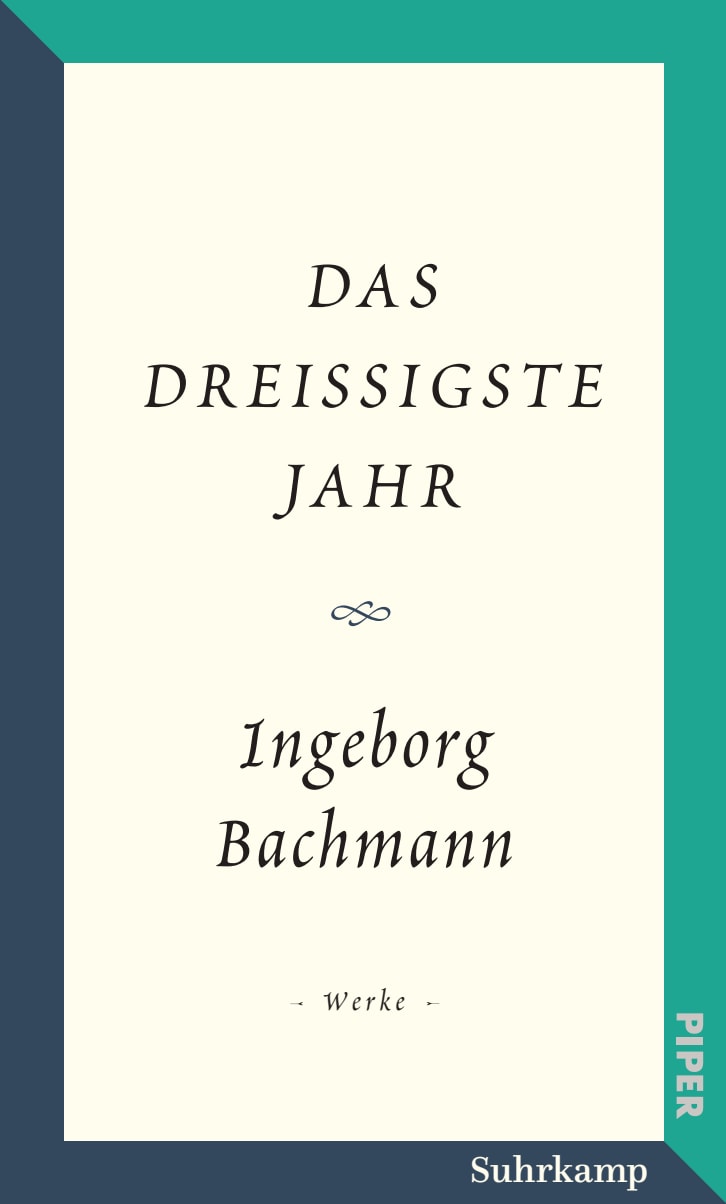
The Thirtieth Year


In 1956, at 30 years of age, Ingeborg Bachman began with the first drafts for the book, which is now to published in the Salzburger Bachmann Edition. It would take five years until all seven stories had been submitted to Piper Verlag ready for publication in the spring of 1961 and the first volume could be published in July that same year.
Of the writing phase the poet, essayist and author of radio plays said that it was a »move within the head« that also...
In 1956, at 30 years of age, Ingeborg Bachman began with the first drafts for the book, which is now to published in the Salzburger Bachmann Edition. It would take five years until all seven stories had been submitted to Piper Verlag ready for publication in the spring of 1961 and the first volume could be published in July that same year.
Of the writing phase the poet, essayist and author of radio plays said that it was a »move within the head« that also encompassed her life. For the publication announcement she asked for the explicit note that this was neither »poetic prose« nor a »collection of stories«, so as to avoid any genre specification; what was important to her was the internal cohesion, the »sign of utopia« that connected all her stories.
For here too we are dealing with the »story within the self«. It is discernible in the biographically significant titles Youth in an Austrian City or The Thirtieth Year, but is most immediate in the story whose title character seems the farthest removed from our world: In Undine’s Valediction, this unique evocation of art and the drama of art and life, which forms the conclusion of the volume.
The narrative power of Ingeborg Bachmann is articulated in the scenic-analytical dimension that eminently emphasises cognition, the sense for linguistic micro-scenes, in which she focused the different forms of exercise of power and violence.
Persons
Ingeborg Bachmann
Ingeborg Bachmann was born on June 25, 1926 in Klagenfurt. She first rose to prominence as a poet after reading her work at a gathering of the legendary Gruppe 47. She went on to publish two collections of poetry, Die gestundete Zeit (1953) and Anrufung des Großen Bären (1956), along with numerous radio plays, essays, and short story collections. In 1971, she published her only completed novel, Malina. Bachmann passed away on 17 October 1973 in Rome.
Ingeborg Bachmann was born on June 25, 1926 in Klagenfurt. She first rose to prominence as a poet after reading her work at a gathering of the...
OTHER PUBLICATIONS

»What Are We Going to Do With Our Lives?«

»Senza casa«


»We Didn’t Do Well« – The Bachmann Frisch Correspondence
Spring 1958: Ingeborg Bachmann – celebrated poet, winner of Literary Prize of Gruppe 47 and cover star of Der Spiegel – is broadcasting the radio play Der gute Gott von...
English world rights (Seagull), Italy (Feltrinelli)
Domestic Rights Sales: German Audiobook (speak low)

Invocation of Ursa Major
The verses in Ingeborg Bachmann’s second collection of poetry, Invocation of Ursa Major (1956), caused a sensation when they were published and soon became canonised: they were immensely...
Italy (Adelphi)


»Write down everything that is true«
The hitherto unpublished and unknown correspondence between Ingeborg Bachmann and Hans Magnus Enzensberger allows one to relive how, after the Second World War, two of the most prominent writers in the German language chose to depict and regard the world, literature and the publishing industry, but also how they wished to present and be regarded themselves.
One was...

Male Oscuro
Ingeborg Bachmann’s dream notes, correspondence drafts and records from the time of her illness are of great literary interest as the primary elements of the subsequent Todesarten-texts. In addition, these writings are apt to further our knowledge about her illness and the phenomenon of illness itself. They are outrageous, courageous in their analytic approach, defeated...

The Book Goldmann
The Book Goldmann is the name Ingeborg Bachmann gave to her great narrative project, which she cherished until the end. This edition renders the previously only fragmentarily...
Turkey (Can)

The Radio Familiy
English world rights (Seagull), Turkey (Can)

War Diary
English world rights (Seagull), France (Actes Sud), Italy (Adelphi), Poland (Czarne), Denmark (Grif), Czech Republic (Pulchra), Ukraine (Osnovy), Israel (Hakkibutz Hameuchad – Sifriyat Poalim), Bengali rights (Kromosho Prakashan)
Previously published in the respective language / territory; rights available again: Spanish world rights (Akal)
Domestic Rights Sales: German Audiobook (Audiobuch)

Herzzeit – The Bachmann–Celan Correspondence
English world rights (Seagull), Portuguese rights (Antígona), Chinese simplex rights (China Renmin UP), Russia (Ad marginem), France (Seuil), Italy (Nottetempo), Netherlands (Meulenhoff), Denmark (Vandkunsten), Sweden (Ellerströms), Japan (Seidosha), Poland (A5), Czech Republic (Pulchra), Bulgaria (Panorama), Romania (Art), Turkey (Kirmizi Kedi), Ukraine (Knihy XXI), Georgia (Ibis)
Previously published in the respective language / territory; rights available again: Spanish world rights (Fondo Cultura), Croatia (OceanMore)

Malina
In Malina, originally published in German in 1971, Ingeborg Bachmann invites the reader into a world stretched to the very limits of language. An unnamed narrator, a writer in Vienna, is...
USA & Canada (New Directions), UK & Commonwealth (Penguin), Spanish world rights (Nórdica), Russia (AST), Brazilian Portuguese rights (Estaçao Liberdade), Portuguese rights (Antígona), France (Seuil), Italy (Adelphi), Netherlands (Koppernik), Denmark (Grif), Sweden (Ellerströms), Korea (Minumsa), Japan (Chikuma Shobo), Czech Republic (Opus), Bulgaria (Panorama), Serbia (Kontrast), Turkey (Yapi Kredi), Greece (Potlatch), Albania (Aleph), Ukraine (Fabula), Georgia (Palitra L), Armenia (Antares), Azerbaijan (Alatoran), Iran (Whale Publishing)
Previously published in the respective language / territory; rights available again: Spanish world rights (Akal), Catalan rights (Edicions 62), Norway (Bokvennen), Finland (Weilin & Göös), Poland (A5, Polish audio book: Mala Litera), Slovakia (Slovensky Spisovatel), Hungary (Jelenkor), Bulgaria (Na Otetschestwenia Front), Romania (Humanitas), Lithuania (Lithuanian Writers Union), Slovenia (Pomuska Zalozba), Macedonia (Tri), Israel (Hakibutz Hameuchad / Sifriat Poalim)
Domestic Rights Sales: German Book Club (Büchergilde Gutenberg), German Audiobook (DAV), German Radio Play (HR2)

Deferred Time
For the young Ingeborg Bachmann and her generation, the great hope after the war soon proved deceptive. The themes in Bachmann's first volume of poetry, Deferred Time (1953), are representative of the experience that defines writing after 1945: Departure and farewell, guilt and memory. In the dramatic gestures and memorable images of her poetic language, this experience found a...